
YACCO kitabına göre, Xavier Chauvin (ETAI) tarafından yazılan L'huile des record du monde.
HISPAO-SUIZA, parent company
In 1904, Swiss engineer Marc Birkigt (1878-1953) joined two Spanish businessmen Damian Marteu and Francisco Seix to found Hispano-Suiza Fabrica de Automobiles SA in Barcelona. The ambitious company aims to produce luxury cars. The firm decided to establish itself in France in 1911 - the country at that time had one of the strongest automobile industries in the world.
The Great War put a temporary end to Marc Birkigt's dreams of expansion, while the Hispano factory in Bois-Colombes was brought under the control of Gnome et Rhône.
Despite these difficulties, the brilliant Swiss technician managed to impose on the French army a new type of aircraft engines, of which about twenty-five thousand were produced by 1918. The largest part is subcontracted by Renault or Lorraine Dietrich.
Peace returned, the company faced a sharp decline in orders. The facility is expanding into the automotive sector once again, but hopes to diversify into commercial aviation as well.
The creation of omo
Hispano's executives want to create a subsidiary dedicated to the manufacture of machine tools and the distribution of tools and lubricating oils. OMO (For Tools and Machinery-Tools) was registered in the Seine trade register on 20 December 1920. Brilliant businessman Jean Dintilhac took over the new company.
It turns out that the development of OMO is cumbersome. French industry experienced an alarming crisis after 1918. While the very young OMO struggled to establish itself in a difficult context, many of its better established competitors were on the verge of bankruptcy.
First year turnover
512,853 francs. (227,526 francs for oils).
Machine tools: - 23,706 francs.
Vehicles: - 49,250 francs.
Oils: + 80,239 francs.
Rise of Yaccolines
While the company concentrates all its work on the supply of lubricants, side activities are decreasing very rapidly. The rise of automobile and road transport creates significant oil needs. Garages are opening on the roads. Aviation also requires quality oils adapted to the requirements of increasingly efficient and sophisticated engines operating at very high speeds. OMO, the preferred partner of Hispano-Suiza, distributes more and more oils under the brand name Yacco, which registered its name in August 1920 with Jean Dintilhac (he had already registered the name "Yaccolines" in November 1919). The term, which uses the last syllable of the surname, appeals to the public with an American sound.
Yacco products quickly earned a reputation for quality and seriousness among professionals. First exhibited at the 1923 Motor Show, the company began forging links with automobile manufacturers such as Jean Dintilhac, a leading engine manufacturer and well-known aircraft engine manufacturer, Salmson. He sponsors an employee of the firm, a certain Thévenet. An amateur driver in his spare time, the latter ranks his personal Amilcar at local car races. The modest Cyclecar, painted in Yacco colors, has had some success. Visionary Jean Dintilhac had already sensed the growing importance of advertising through its best vector, competition.
The irresistible rise
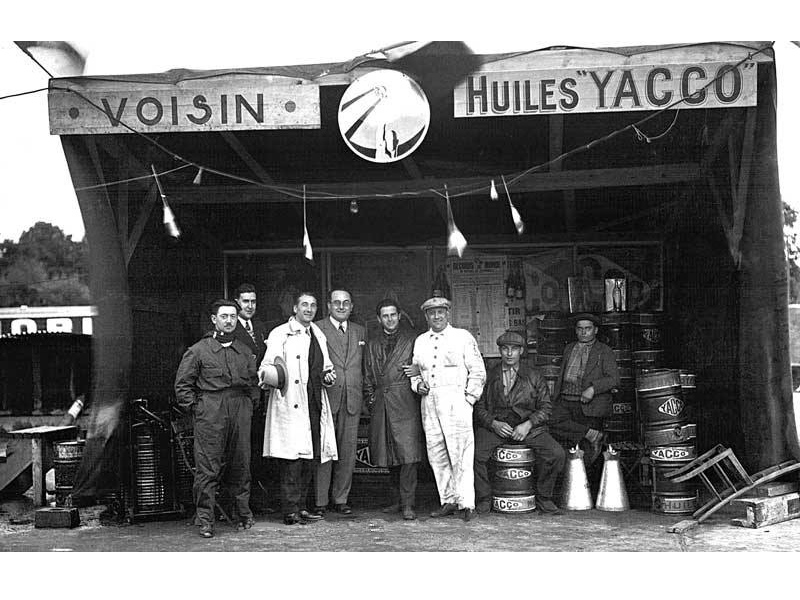
The company grew steadily, bringing its capital to 2,000,000 francs in March 1924. Moved to larger facilities in Courbevoie. At the same time, the board welcomes several additional members: Emile Mayen, the new chairman; The new vice president, Alfred Gerson, and Jean Lacoste, all appointed to a six-year term, were soon joined by secretary René Martinat and then Pierre Forgeot. A political personality of the first order, the deputy of the second Marne. Yet the charismatic Jean Dintilhac still holds the dominant position in the company he manages with the same skill. It can boast of counting the prestigious Voisin, an outstanding production, among its clients.
The tireless Jean Dintilhac, who tirelessly approached manufacturers, managed to win exclusive contracts with fashionable small brands for bicycle carts, such as Benjamin, BNC, Derby, Amilcar or Vinot-Deguingand. Magnat-Debon puts a sticker on the tanks of their motorcycle: "Yacco lubrication only". Jean Dintilhac, on the other hand, is confronted by the "stubborn" (ditto), Peugeot, Lorraine-Dietrich or Hotchkiss, who refuse any partnership with the firm.
The factory broke sales records: for example, during the month of September 1924 2016 a total of 2016 cases sold 329 barrels and 68 barrels (A case usually contains ten to twelve 2-liter cans, one barrel has a 200-liter capacity and a 60-liter keg). The turnover continued its irresistible advance: 1,841,860 francs in 1923, 4,577,612 francs in 1924, and more than 8,000,000 francs in 1925. Yacco planned to establish a new ultra-modern production facility in Rouen from November 1924. The same ambitious Jean Dintilhac began negotiations with André Citroën at the end of the year, despite purchasing his materials from competitor Mobil. The Quai de Javel is on the rise, and Yacco has high hopes for a partnership with the French auto industry's youngest child.
Yacco excitement
In April 1926, the firm changed its corporate name. The name OMO is definitively eliminated and replaced by the new "Yacco SAF" (for Société Anonyme Française). A second capital increase was made in November 1928, now reaching 4,500,000 francs. Head office has moved to number 44, rue de la Grande-Armée, in the 16th arrondissement of Paris. In the same year, a new factory was opened in Aubervilliers. In January 1929, Marc's son, Louis Birkigt, joined the board of directors.
Voisin definitely adopts Donnet as well as Yacco oils. Yacco - Donnet and Yacco-Voisin oils are distributed through brand agents. The icing on the cake is Guiseppe Campari's Alfa Romeo 6C 1750 oiled by Yacco, winning the Mille Miglia in 1929.
Although the automotive industry is doing well, aviation cannot be left behind. Collaboration with Hispano-Suiza is in good standing: the Stork brand distributes 20-liter cans packaged by Yacco under its own name. He increased his contacts with Jean Dintilhac, Caudron-Renault, Farman, Blériot and Nieuport-Delage. Despite the unequivocal results, Jean Dintilhac struggled to win major contracts with the Air Force. In October 1930, Emile Mayen and Alfred Gerson resigned. They were replaced by Marc Birkigt and Pierre Forgeot, who were appointed president and vice president respectively: the company is more connected than ever before with the aerospace field, which was then experiencing unprecedented expansion.
Neighbors world records
Unconventional, Gabriel Voisin is contextless, one of the most prominent personalities in the Paris of the Roaring Twenties. He can be counted among his close friends Rudolf Valentino, Mistinguett or Le Corbusier, who often drives as a Voisin. As early as 1925, atypical cars were the first to set the speed records held by Yacco on the Montlhéry ring, with a modest four-cylinder with an aerodynamic body.
The ad tells us that this car broke "seven world records" between November 6, 1925 and February 22, 1926. More ambitious is the eight-cylinder that replaced it, working in the ring from April 12, 1927 to January 12, 1928. He runs twenty-four hours at an average speed of 182.66 km/h and sets the hour record with 206.558 km/h. h. Two formidable twelve cylinders achieve this. The first again won 19 records in its category, while the second is a simple production car that covered more than 50,000 kilometers from September 7-25, 1930.
Gabriel Voisin, fond of original technical solutions, markets only valveless engines such as the Panhard or Peugeot for its most luxurious models. Quieter and more flexible, valveless engines suffer from an astronomical half-liter of oil per 100 kilometers. The wake of the car is accompanied by an unavoidable blue plume, which is unfortunately quite apt! Therefore, the use of a quality oil is essential for the longevity of the mechanics. However, conventional engines will make great progress and will certainly replace valveless engines by the end of the 1930s.
Rosalie's exploits
In the early 1930s, Yacco experienced a series of disappointments with its main customers in serious financial trouble: All deals with Amilcar, Donnet and Voisin were terminated. Jean Dintilhac has been courting André Citroën for several years, whose contract with Mobiloil continues. A B14 taxi has been tested for a long time with Yacco oil: it has proven to be less wear and tear on its main mechanical components after disassembly. Jean Dintilhac bought a C6 F chassis from Citroën to embark on a new set of records in the Montlhéry speed ring. Quite reserved for such events, André Citroën openly admits that he prefers long-distance raids like the famous cruises. It will take all the persuasion of César Marchand, the former driver of Voisin des Records,
Purchased by Yacco in early 1931, the C6 F was transported to César Marchand's workshop in Issy-les-Moulineaux, where it received a streamlined aluminum body. The team consists of several pilots who will make a turn every 500 kilometers: Raphaël Combette and Louis Leroy de Présalé, in addition to César Marchand and his brother Julien. This very special C6 F competes in category D reserved for vehicles with a cylinder capacity between 2000 and 3000 cm3. The christened “Rosalie” race car set off on October 22, 1931, and didn't stop until November 1. Rosalie I broke fourteen international records by lasting 222 hours, 38 minutes and 56 seconds at an average speed of 108,511 km/h.
Encouraged by this success, Jean Dintilhac purchased a chassis for the new C6 G, prepared with the same thought. Rosalie II would run fifty-four laps from March 5 to April 29, 1932, before breaking the Celoron timing assembly. Forty days later, he broke many records by breaking 100,000 km at an average speed of 104,331 km/h. That's why the Rosalie II is the first French car to cover such a distance at such a high speed.
André Citroën, who until then had been quite timid about Yacco's venture, was pleased with these promising results. He announced to the press that he wanted to offer a bonus of 1,000,000 francs to anyone who could beat Rosalie II before 1 October. A challenge well known to the master of the Quai de Javel, impossible to meet in such a short time. Built on the basis of the new 15 Légère, Rosalie III entered the runway on April 6, 1932. Later, Rosalie III was renamed Rosalie V, while the number IV was attributed to little Rosalie. La Rosalie V continues to break records, repeatedly dethroning the records set by La Voisin two years ago. Little Rosalie keeps spinning as she enters the ring...
Little Rosalie enters the legend
Rosalie IV appears as the most famous representative of the line. It uses the most modest 8 CV chassis of the Citroën series and therefore competes in the F category. The machine sets off on the Montlhéry circuit on 15 March 1933 and does not stop until 27 July. Over the course of 133 days, the lean Citroën will have covered approximately 300,000 kilometers at an average speed of more than 93 km/h, under the supervision of five track marshals and eight timekeepers from the ACF. On March 18, he had to stop for six hours due to heavy snowfall. As time passes, it will catch up thanks to the dexterity of its pilots. A feat masterfully crafted by César Marchand's team.
As in previous records, as described in the extensive inventories of the time, the car had to carry a large number of spare parts in its trunk: forty spark plugs, three valves, forty-one segments, a spare wheel, three grease nipples, three fuel hoses, two clamps, two fuel pumps, a front engine support, six radiator hoses, two ventilation belts, six dynamo brushes, an oil ramp, a spring caliper, two mounts shock absorbers, a complete shock absorber, two headlight bulbs and windows, nineteen leaf springs, a half-moon valve switch, and three distribution latch...
The Rosalie phenomenon grows within weeks. In the face of this growing success, André Citroën then showed a certain optimism, encouraging César Marchand to aim for 500,000 kilometers.
advertising fallout
André Citroën, a communications virtuoso, provides a magnificent staging for the event. A grand reception is held on the racetrack. Before July 1, 1935, he announced to reporters that he wanted to offer a total of 3,000,000 francs to anyone who could beat Petite Rosalie. Embrace Marchand, where the Chevron brand presents its new 15 Légère sedan, the best of its range. César Marchand will then host a number of conferences organized by Citroën or Yacco, showing short films comparing the record attempt with a true epic. Loaded on a special truck, the record car embarks on a promotional tour in France. Posters, signs and brochures of all kinds describe his performances. Citroën toys produce thousands of miniatures with its own image. This victory...
This celebrity is clearly reflected in Yacco, who has gained significant prestige from him. However, speed records are putting the small oil firm's finances a bit of a strain. Full of debts, André Citroën struggles to pay the costs he has agreed to pay. Despite his promises, André Citroën has renewed his contracts with Mobiloil despite the media success of Rosalies.
The company's debts are getting heavier. The flagship of the French automotive industry is on the verge of bankruptcy. Citroën owes more than 160,000 francs to Yacco, which suspended its deliveries at the beginning of 1934. Quai de Javel finally comes under the control of the Michelin brothers, removing André Citroën from management. And Mobiloil remains largely the factory's main supplier for Yacco, which is losing one of its most promising partnerships.
Additional recordings
The repercussions of the Great Depression in America are beginning to be felt in Europe. Things were far from developing and many small builders who had been loyal to Yacco by that time had to close their doors. Still, the years 1933 and 1934 remain on record as prosperous periods. Jean Dintilhac reproduces more or less successful trials. Ford SAF president Maurice Dollfus joins the board. Yacco maintains close ties with the American company that will soon become associated with Alsatian Emile Mathis. Shortly before the release of Petite Rosalie, Jean Dintilhac entered Agathe from March 6-14, 1933. It was a massive Ford 19 CV equipped with a generous 3.3-liter four-cylinder engine that won ten international records.
A 15 CV Légère named “Rosalie VI” set seven international records on his list between 7-9 April 1934 (Top speed exceeds 180 km/h, fastest time is Rosalie). It is currently taking over the registrations of its only serious competitor, the enthusiast Citroën 15 CV Spido.
Yacco increased its contacts with Small Entente countries such as Czechoslovakia. It hopes to supply oil to Skoda (remember, it was founded with French capital) and plans to operate a Skoda in Montlhéry. In the absence of conclusive results, the idea was quickly abandoned, although Yacco did manage to do some work with its local counterpart, Apollo oils.
Compromise with Peugeot
Despite problems with Citroën, Yacco continued to manage Rosalies at Montlhéry. Rosalie VII works from 17 to 23 July 1934. In addition to the inevitable record harvest, this Rosalie has the distinction of being the first series to borrow the base of a Traction Avant (in this case, a Coupé 7 CV). . Replaced July 22-29, 1935, the Rosalie VIII was a former 15 CV that still benefited from a compressor with the desire to drop the 15 CV Spido for sure. It averages 15,000 kilometers at a speed of around 145 km/h, maintaining outstanding averages for the duration.
Jean Dintilhac approaches Peugeot. He received a 301 chassis, equipped with a peaceful 1465 cm3 with 37 hp. The car was immediately entrusted to César Marchand, and he fitted it with a roadster body that was as elegant as it was light. It thus offers a top speed of 110 km/h. The two men want to start a new record format by rolling the beautiful Peugeot named "Delphine" on the open road. It began its journey on January 2, 1935, and covered 100,000 kilometers at an average speed of about 60 km/h, the route that made stops at the main Peugeot dealerships. First of all, Delphine is wrapping up her tour of France by covering 10,000 kilometers in Montlhéry from September 12-16 and winning several records according to home habits.
Fashion for road records
The well-received Delphine adventure encourages Jean Dintilhac to renew the experience. Such records achieved on the open road are less ostentatious but more accessible to the public. César Marchand's team, quoted by Peugeot and Citroën dealers, repeated the same formula in 1936 in the Delphine II and Rosalie IX, the simple 402 and Traction 11 CV sedans. The latter covers more than 100,000 kilometers in daily stages of 1,500 kilometers per day.
Finally, in 1937, Jean Dintilhac set his last record attempt at Citroën: He went to a curious Yacco Spéciale Montlhéry circuit between 22-31 July. Also briefly marketed by the manufacturer is a Rosalie powered by a short-lived Diesel engine.
At the same time, Talbot's buyer, Anthony Lago, contacted Yacco. Powerful in the prestige of their production, the seductive Anglo-Italian (Talbots were among the most beautiful sports cars of the time) was ready to recommend Yacco oil, provided the oil company supplied the lubricant and gave it for free. 50 franc bonus for every car that leaves the factory. As you can imagine, the case will not succeed...
La Claire, a women's affair
The majestic Claire set out on the Montlhéry circuit on May 18, 1937. It is a Matford registered in category C (3,000 to 5,000 cm3), equipped with a generous 3,631 cm3 V8 Flathead. The originality of this ultimate attempt to set a record on a slow track stems from its crew of the best female drivers of the time: Odette Siko (team captain), Simone des Forest, the eccentric Hellé Nice and Claire Descollas - The name is drawn to name the car for the first time. For ten days, it will spin at an average speed of more than 140 km/h in the great Matford speed ring, once again pocketing ten world records and fifteen international records.
motorcycle records
Gnome & Rhône, a talented engine manufacturer specializing in aircraft engines, is also a famous motorcycle manufacturer. Closely linked to the French army, the company wants to demonstrate the sturdiness of its machines by launching grandiose raids. Yacco, which already supplies oil to the aviation branch, immediately joined the project. In September 1936, fiercely competitive, Gnome & Rhône recruited reckless Gustave Bernard, one of their top pilots, in the footsteps of the legendary Orient-Express. Attached to a basket, the large 750 X connects Budapest with Paris - a distance of 1519 kilometers - in less than twenty-four hours, beating the famous train, considered one of the fastest of its time.
Encouraged by this success, Jean Dintilhac launches the Gnome & Rhône to attack Montlhéry's circle. Various campaigns were organized between 1937 and 1939 according to a proven recipe. Between 2 and 6 June 1937, the motorcycle traveled 10,000 kilometers at an average speed of 109.20 km/h and had the support of the brand's pilots and also (and this was the first) motorized army officers. On October 14 of the same year, the 750 X broke the 24-hour record with 136,536 km/h. Another harvest took place in 1938: Between June 30 and July 5, Gnome & Rhône covered more than 20,000 kilometers and, among other things, set the 4,000 kilometer record at an average speed of 116.26 km/h.
The last attempt on the eve of the war (June 19 - July 8, 1939), the always brave 750 X passed 50,000 kilometers at an average speed of 109.38 km/h. Attached to a sidecar (with a drive wheel), this excellent motorcycle is comparable to BMWs and other Zündapps. The Germans are infallible: samples captured at the end of the Battle of Fone will be returned to German units, some even going to fight on the Russian front...
Partner of Air France
Thanks to its privileged links with Hispano-Suiza, Yacco has a preferred position in the emerging commercial aviation industry. The Bois-Colombes manufacturer's excellent engines fit most first-row aircraft, the Dewoitine D.338 (Marc Birkigt was one of Emile Dewoitine's main partners), the Lioré & Olivier H-242 or the Breguet 393 T, flying under the banner. very young company Air France. The prestigious airline is undoubtedly the perfect introduction.
But beyond the media effect, the use of Yacco oil is essential to keep engines running smoothly. It corresponds to very restrictive technical requirements. Airlines operate at very high speeds for hours on end, their reliability depends on the safety of flights and passengers. The slightest mechanical failure can have dramatic consequences.
Marcel Doret
A legendary figure in the early days of aviation, Marcel Doret was eighteen when the Great War broke out. As a volunteer, he served three years in artillery before requesting his post in the air force. After taking classes at the Hunting and Aerobatic School in Pau, he earned a license as a military pilot in 1918. The reckless young pilot became a test pilot with Dewoitine after the war. A pioneer in aerobatics, he performed the wildest stunts under the control of the famous red and yellow Dewoitine D.27, a hunter equipped with a 300 hp Hispano-Suiza engine. Then fashion, airshows, and undisputed star Marcel Doret mobilize considerable crowds. In 1927, Marcel Doret won a major victory at the aerobatic meeting at the Dübendorf airport near Zurich. Marcel Doret, crowned at the end of the "King of the Air" competition, is at the peak of his career. Here Yacco finds the ideal partner to boast of the quality of its products.
War
The end of the 1930s, though rather bleak, announced a certain recovery in the economy. Because France is inevitably preparing for war. The government is ramping up orders for arms, which is stimulating the industry. In May 1938 Pierre Forgeot was appointed chairman of Yacco. The military is accumulating huge oil stocks for the conflict. The company is building additional large-capacity tanks at its new factory in Rouen. Yacco is once again experiencing a short period of expansion, unfortunately. In May 1939, Maurice Dollfus resigned as he was too busy managing Ford SAF. France enters the war in the fall and activity slows. Standard Oil stole many of Yacco's contracts with Allied troops.
The German offensive in May 1940 would put the company's future in grave danger. On the orders of the French military authorities, the Rouen factory is set on fire to prevent the invading troops from taking it. Yacco's production capacity has been reduced to zero.
Pierre Forgeot resigned in December 1940 and was replaced by Jean Dintilhac. Due to the lack of raw materials, the company finds itself on the verge of bankruptcy. In March 1941, the board met in Vichy in the guise of a temporary re-established head office in a small spa town. The delivery of heavily rationed petroleum products is then de facto prohibited.
Jean Dintilhac tried to divert the company to other activities as best he could. He is trying to develop fat substitutes based on herbal products. Yacco researchers were set up in Le Croisic, a small seaside resort in the Loire-Atlantique. The year 1944 was reduced to a minimum: 9,255,645 francs versus 17,877,133 francs in 1943. The company was in bad shape when salvation came. In December 1944, Jean Dintilhac paid the price of this troubled period and was dismissed from the board of directors. Provoking speed records, Yacco's spirit vanishes from the landscape of the society he helped build...
postwar
André Marcellin succeeded Jean Dintilhac as president, while Marius Dasté became managing director of the company. The Forgeot family returned to business with André, followed by his brother Jacques, who was soon appointed manager. The latter manages the Commercial advertising loan, one of Yacco's main shareholders. Pierre Picard, a figure of the Resistance (comrade of Liberation), also joined the board. He will be president from February 1960 to March 1982. Therefore, a new and dynamic team that will work to raise the prestige of the company. Yacco will rise from the ashes in a few years...
2 CVs of records
In 1953 the Montlhéry speed ring housed a record car in the great tradition of the 1930s. It was a Citroën 2 CV - an original choice if any - radically converted by the Barbot engineer. Engine capacity has been reduced from 375 cm3 to 350 cm3 to compete in the J class. The curious race car driven by Barbot and Vinatier father-son (young Jean would later have a good career in Alpine) takes off. September 27. It travels at an average speed of 90.96 km/h for twelve hours and 85.02 km/h for twenty-four hours.
competitive success
Yacco can boast of some great achievements. A Monopole barket (with a Panhard engine) took the Performance Index in the 24 Hours of Le Mans in 1952 (Team Hémard-Dussous) and a class victory in the 500-750 cm3 category. At an average speed of more than 116,758 km/h, it knocks down the legendary Le Mans event.
In 1953, a powerful Jaguar XK 120 (team Peignaux-Jacquin) won the Lyon-Charbonnières rally. Famous Monegasque champion Louis Chiron won the Monte-Carlo rally at Lancia Aurélia. Exploits widely cited by advertisements.
DS epic
Yacco gets even closer to its legendary partner by sponsoring the chevron brand in various symbolic competitions. With its excellent handling and outstanding performance on all slippery surfaces, the DS proves to be the ideal mount for rally. Paul Coltelloni became European champion in 1959 at the wheel of a faithful ID 19. A beautiful victory at Monte-Carlo and a few class victories at the gruesome Liège-Rome-Liège or the Acropolis rally. Yasso then teamed up with René Trautmann, who was at the peak of his career. At the end of a remarkable season, Citroën's iconic star driver became the French rally champion in 1963.
Citroën is on the rise and wants to shine in major international competitions. Fashion is for big road marathons like the Baja 1000 or the very demanding City of London-Mexico. Quai de Javel decides to assemble a five-car team there for the 1970 edition. Yacco is clearly part of the game and once again finds René Trautmann. The operation was successful and René Trautmann won the event. The other four teams (including one woman) manage to reach the finish line and collect the third, seventh and twelfth places. The firm later sponsored two SMs entered by Guy Verrier (head of the competition at Citroën) at the 1972 24 Hours of Le Mans.
Back to 24 Hours of Le Mans
In 1973, Jean-Claude Andruet and Richard Bond set off for the famous Le Mans event behind the wheel of a magnificent Ferrari 365 GTB 4 Daytona, entered by the Belgian Francorchamps team. They will finish in twentieth place with an average of 153.877 km/h per hour. In 1979, Yacco supported the La Pierre du Nord team, which drove two Chevron B16s with Chrysler Roc engines. Two very beautiful trays reflecting the spirit of a certain period...
hits of the 1980s
Yacco invests in competition, notably sponsoring 1981 French mountain champion Marc Sourd in the Martini Roc F2. A discipline may be less publicized but very popular with a certain insider audience. Yacco also collaborated with Daf, which entered the 1988 Paris-Dakar in huge Bull trucks with nearly 1,000 hp. Masterfully driven by Jan de Rooy, these impressive vehicles prove to be almost as fast as the legendary Peugeot 205 Turbo 16. Loyal 1988 Ford Cargo. A list that is not as comprehensive as the harvest of victories – all disciplines and categories combined – important…
Efficient partnership with Audi…
By the mid-1980s, the ring brand was on the rise from the competition thanks to the outstanding Quattro and other 200 Turbos. Jacques Aïta was the French rallycross champion in 1985, while Xavier Lapeyre won the French Production championship the following year. Very good results for state-of-the-art vehicles…
…and with Mercedes-Benz
The star brand also collects several laurels in cooperation with Yacco. The excellent Mercedes 190 E 2.3 liter 16 valve was used in the DTM in the 1991 season by Jacques Lafitte and Dany Snobeck became his teammate. The latter won the Andros Trophy twice, in 1992 and 1993.
The saga of the Yacco brand's sporting achievements did not stop in the early 1990s. For over three decades, many pilots, trainers and enthusiasts continue to build the Yacco legend.
